Story Elements for Kids: The 5 Parts of Every Children's Story
The five story elements for kids — setting, characters, plot, conflict and resolution — explained in plain language, with what to teach at each age.
The five story elements for kids are setting, characters, plot, conflict and resolution — where and when a story happens, who it is about, what happens, what goes wrong, and how it is put right. Children can name characters and setting from about age three, and handle conflict and resolution by eight or nine.
Great children's stories can be silly, gentle, adventurous, magical, educational, or deeply comforting. But most of them share these core ingredients.
Whether you are reading aloud, helping a child write, teaching a class, or creating a personalized story with ZunoTales, these five elements make the difference between a story children merely hear and a story they remember.
The 5 story elements, in plain language
Before the craft, the vocabulary. If you are teaching story elements to a child — or reminding yourself before you do — these are the five parts almost every classroom uses.
| Element | The question it answers | How to explain it to a child |
|---|---|---|
| Setting | Where and when? | "Where is our story happening, and is it day or night?" |
| Characters | Who is it about? | "Who is our story about, and who else is with them?" |
| Plot | What happens? | "What happens first, then next, then right at the end?" |
| Conflict | What goes wrong? | "What is the problem our hero has to solve?" |
| Resolution | How does it end? | "How does the problem get fixed, and how does everyone feel?" |
These questions are a starting point for discussing a story. Understanding also includes vocabulary, inference and the ideas a reader takes from it.
Free printable: story elements chart
A two-page chart to print for your class or kitchen table. Page one is draw and tell for ages 4–6: a box for each element with a simple question and room to draw. Page two is plan and write for ages 7–10, with lines to retell a story they have read or plan one of their own.
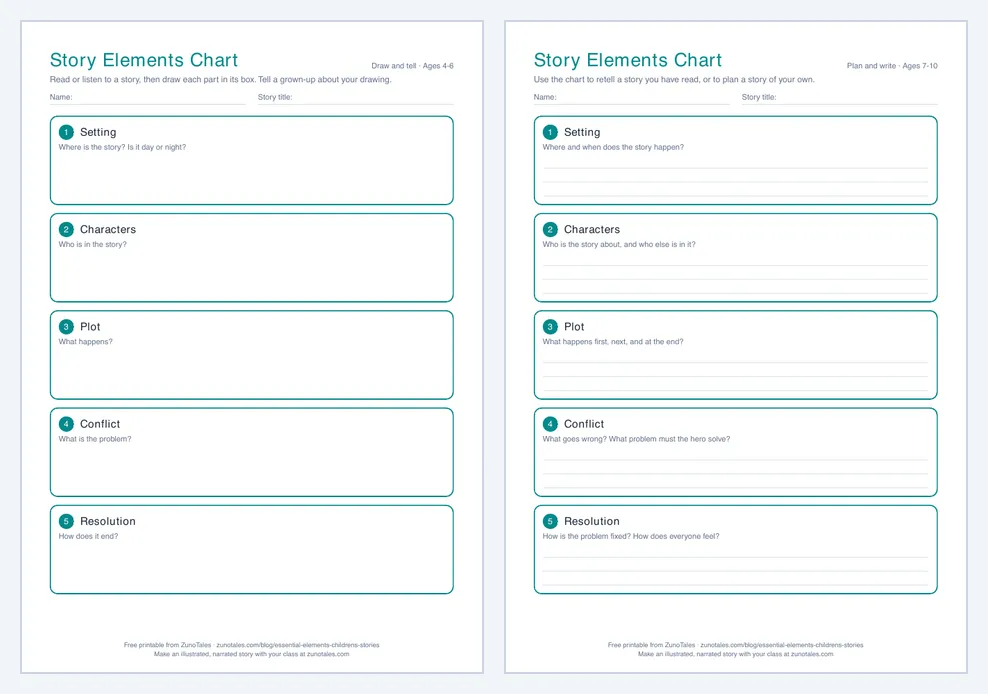
Download the story elements chart (PDF, A4, free). No sign-up needed.
The rest of this guide is about the harder part — not naming the five elements, but making each one good enough that a child asks for the story again.
A complete example: Pip and the paper boat
An original fictional example for shared reading; no child profile is used.
After the rain, Pip the rabbit found a wide puddle beside the garden gate. Across the water, his friend Tilly held a packet of sunflower seeds.
“I promised to plant these with you,” Tilly called, “but my boots have a hole!”
Pip tried to reach across with a twig. Too short. He laid a leaf on the water. It curled up and sank.
Then he noticed the paper wrapping from his picnic. He folded it into a little boat and tested it close to the edge. It floated. Tilly placed the seed packet inside, and Pip gently guided the boat across with his twig.
They planted the seeds on Pip’s side of the gate. When the puddle dried, Tilly came over to help water them.
“Our boat only carried seeds,” said Pip, “but we still grew something together.”
Find the five elements
- Setting: the garden gate after rain.
- Characters: Pip and Tilly.
- Plot: Pip tries different ways to bring the seeds across.
- Conflict: the puddle separates the friends, and Tilly cannot cross in leaky boots.
- Resolution: a paper boat carries the seeds; the friends can plant together.
Ask your reader: Why did Pip test the boat first? What else could the friends have tried? Which sentence helps you picture the setting?
To write another example, change just one element: a windy day, a different character or a missing watering can. Try Young Author and the story generator, or explore personalized bedtime stories for a gentler evening theme.
Making characters relatable
Children connect with characters before they connect with themes. A strong children's story usually begins with someone the child can understand.
That character might be:
- a curious child
- a shy dragon
- a brave rabbit
- a robot learning feelings
- a tiny star that wants to shine
Relatable does not mean ordinary. It means emotionally recognizable. A child may never meet a dragon, but they understand being nervous, excited, left out, proud, or curious.
Give the character:
- one clear desire
- one small flaw or fear
- one memorable detail
Example: "Pip was a penguin who wanted to sing, but every time he opened his beak, only bubbles came out."
That single sentence gives us a character, a goal, a problem, and a playful hook.
Making the plot work
An engaging plot does not need to be complicated. In children's storytelling, clarity often matters more than complexity.
A simple structure works beautifully:
- The character wants something.
- Something gets in the way.
- The character tries.
- The character learns or changes.
- The story resolves.
For younger children, the obstacle should be gentle. For older children, the obstacle can involve a tougher choice or deeper mystery.
If you are writing for bedtime, keep the plot calmer. If you are writing for daytime reading, you can add more energy and surprise.
For bedtime examples, see our list of the best bedtime stories for kids.
Conflict with stakes children understand
Children stay engaged when they care what happens. Emotional stakes give the plot meaning.
Good emotional stakes include:
- wanting to belong
- feeling brave
- fixing a mistake
- helping a friend
- trying something new
- finding the way home
Notice that these are not huge, adult-sized stakes. They are child-sized and powerful.
The question is not always, "Will the hero save the kingdom?" Sometimes it is, "Will the little owl ask for help before the moon disappears?"
A setting built from sensory detail
Children love stories they can see, hear, and feel. Sensory detail makes a story vivid.
Instead of saying:
"The forest was magical."
Try:
"The forest smelled like rain and cinnamon, and every leaf hummed when the moonlight touched it."
Strong sensory details include:
- color
- sound
- texture
- smell
- movement
Do not overload every sentence. A few precise details are better than a long list.
Letting a lesson grow from the story
Many children's stories include a lesson, but the lesson should grow from the character's journey.
Good moral lessons often involve:
- kindness
- honesty
- patience
- courage
- curiosity
- responsibility
The lesson should not feel pasted on at the end. If the character learns kindness, the plot should give them a reason to practice kindness.
For example, instead of saying, "Kindness is important," show a character sharing their lantern with someone lost in the dark.
For more examples, read how to tell engaging moral stories to kids.
A resolution that feels complete
Children need closure. The ending does not have to be perfect, but it should feel emotionally complete.
A good ending might show:
- the character returning home
- a friendship repaired
- a fear softened
- a new skill learned
- a mystery gently solved
For bedtime especially, the ending should lower the emotional energy.
Story elements and literary elements: the difference
The two phrases get used interchangeably, and for young children the distinction rarely matters. When it does, it is this: story elements are the parts a story is built from — setting, characters, plot, conflict, resolution. Literary elements is the wider term, covering those parts plus the techniques a writer uses inside them: theme, point of view, mood, figurative language.
For ages five to eight, stay with the five story elements. Around nine to twelve, theme and point of view are usually the next two worth introducing, because by then a child can hold "what the story is about" separately from "what happens in it".
Teaching story elements by age
Ages 3–5. Two elements is plenty: characters and setting. Ask "who is in this story?" and "where are they?" after each read. Naming is the whole skill at this stage.
Ages 5–7 (KS1, Grades K–2). Add plot as beginning, middle and end. A three-box drawing lands better than a definition — one picture per part, in order.
Ages 7–9 (Grades 2–4). Introduce conflict and resolution by name. Children this age usually spot the problem in a story long before they can label it, so start by asking what went wrong, then give the word for it.
Ages 9–12 (Grades 4–6). Add theme and point of view, and start comparing two stories that share one element — the same conflict in a different setting. That comparison is where analysis actually begins.
How ZunoTales Uses These Elements
ZunoTales uses the child's profile, interests, and story idea to shape stories with age-appropriate structure. A story can include the child's favorite topic while still keeping character, plot, emotion, imagery, and lesson in balance.
If your child wants "a rainbow dinosaur who loves soccer," the story still needs a clear character goal, a playful problem, and a satisfying ending. That is where structure supports imagination.
FAQ: How do moral lessons influence story engagement?
Moral lessons influence engagement when they give the character's choices meaning. Children become more invested when a story is not just about what happens next, but why a choice matters. The key is to show the lesson through action rather than explain it like a rule.
FAQ: What is the most important element of a children's story?
If you had to pick one, it is a relatable character with a clear want. Every other element — plot, stakes, imagery, lesson — hangs off a character the child cares about and a goal the child understands. Children follow people (or dragons, or robots) before they follow themes, so a story with a vivid, emotionally recognisable character and one simple desire will hold attention even if the plot is modest. Get the character right first; the rest of the structure has something to attach to. For a step-by-step approach to building a full story around a character, see our guide to storytelling for kids.
FAQ: What are the 5 parts of a story for kids?
Setting, characters, plot, conflict and resolution. Setting is where and when, characters are who it happens to, plot is what happens, conflict is what goes wrong, and resolution is how it is put right.
FAQ: What is the difference between story elements and literary elements?
Story elements are the building blocks — setting, characters, plot, conflict, resolution. Literary elements is a broader term that also covers theme, point of view, mood and figurative language. For primary-age children, the five story elements are the set worth teaching.
FAQ: At what age should children learn story elements?
Characters and setting can be named from around age three. Plot as beginning-middle-end suits five to seven. Conflict and resolution are usually secure by eight or nine, and theme and point of view from about nine onwards.
Final Thought
The essential elements of children's stories are simple but powerful: a relatable character, a clear plot, emotional stakes, sensory detail, and a meaningful lesson.
When those pieces work together, a story becomes more than entertainment. It becomes a small rehearsal for courage, kindness, curiosity, and imagination.